Category: Uncategorized

  • How to Use a Map Scale Ratio

    How to Use a Map Scale Ratio

    A map scale such as 1:25,000 means one unit on the map represents 25,000 of the same unit on the ground.

    Worked example

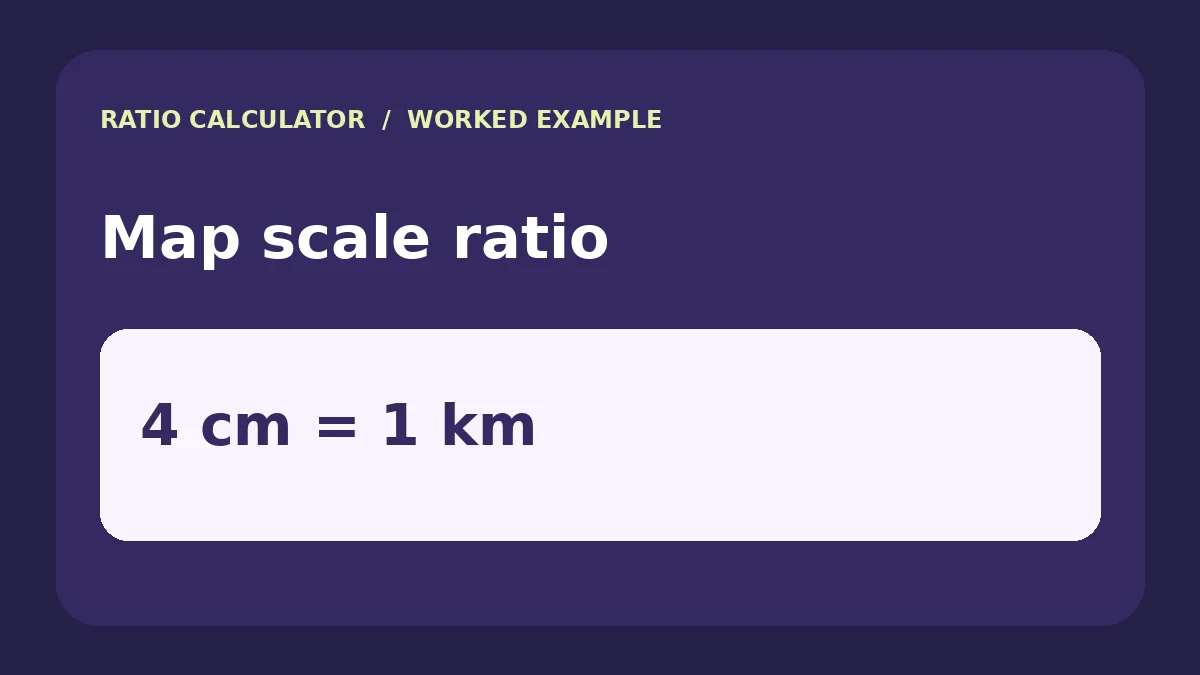
    A 4 cm line at 1:25,000 represents 100,000 cm, or 1 km.

    Check your answer

    Use the scale printed on your copy and check whether the map was resized. A straight line measures straight-line distance.

    Try the Ratio Calculator or explore the Ratio Guides.
  • How to Convert a Ratio to a Fraction

    How to Convert a Ratio to a Fraction

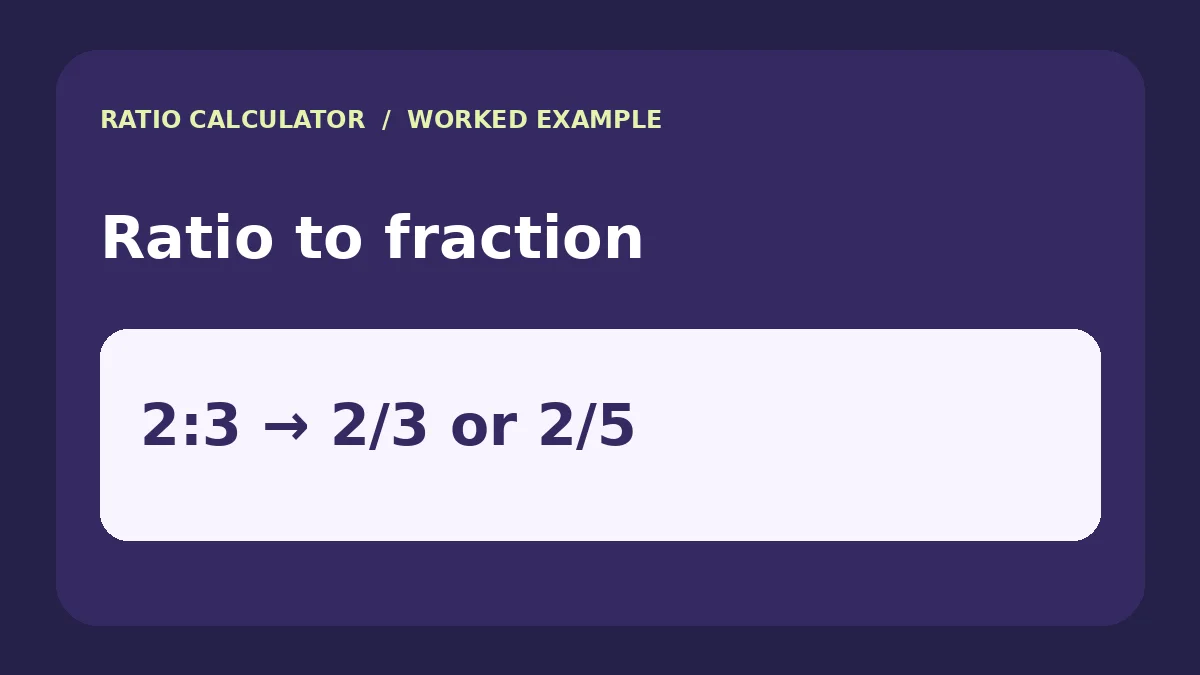
    Write A:B as A/B to express the first quantity relative to the second. For a share of the whole, use A/(A+B).

    Worked example

    A mix with two cups of concentrate and three cups of water has a concentrate-to-water fraction of 2/3. Concentrate makes up 2/5 of the full mix.

    Check your answer

    Check which quantity the denominator represents before simplifying the fraction.

    Try the Ratio Calculator or explore the Ratio Guides.
  • How to Compare Two Ratios

    How to Compare Two Ratios

    For ratios with positive second terms, compare their cross-products. A:B is greater than C:D when A × D is greater than C × B.

    Worked example

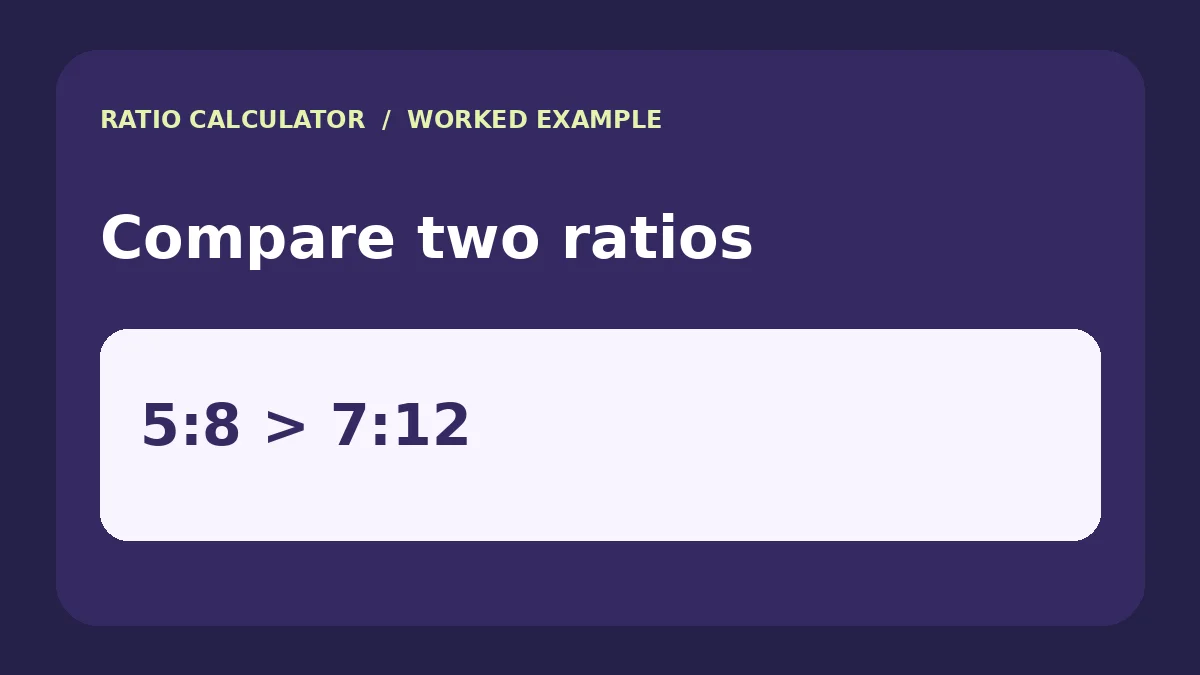
    Compare 5:8 and 7:12. The products are 60 and 56, so 5:8 is greater.

    Check your answer

    Match the order and units first. A ratio of flour to water cannot be compared directly with water to flour.

    Try the Ratio Calculator or explore the Ratio Guides.
  • How to Simplify a Ratio With Fractions

    How to Simplify a Ratio With Fractions

    Multiply both terms by a common denominator, then reduce the resulting whole numbers.

    Worked example

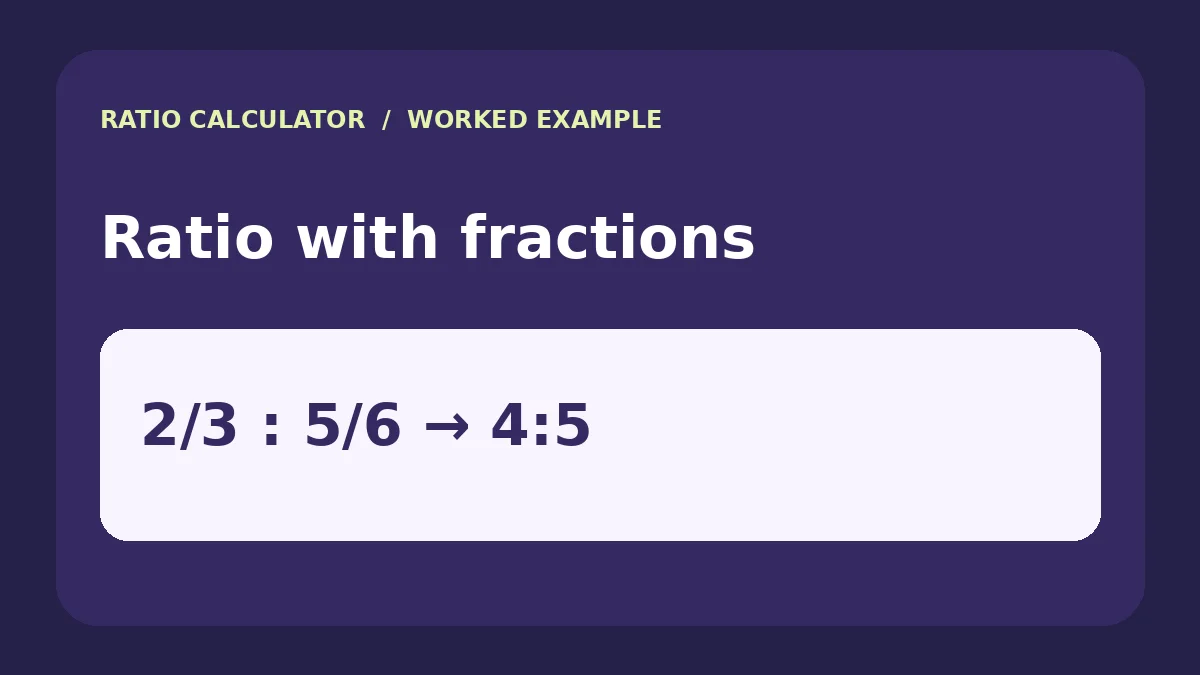
    For 2/3 : 5/6, multiply both terms by 6. The ratio becomes 4:5.

    Check your answer

    The multiplier applies to each entire fraction. Check that (2/3) ÷ (5/6) equals 4/5.

    Try the Ratio Calculator or explore the Ratio Guides.
  • How to Find a Unit Rate

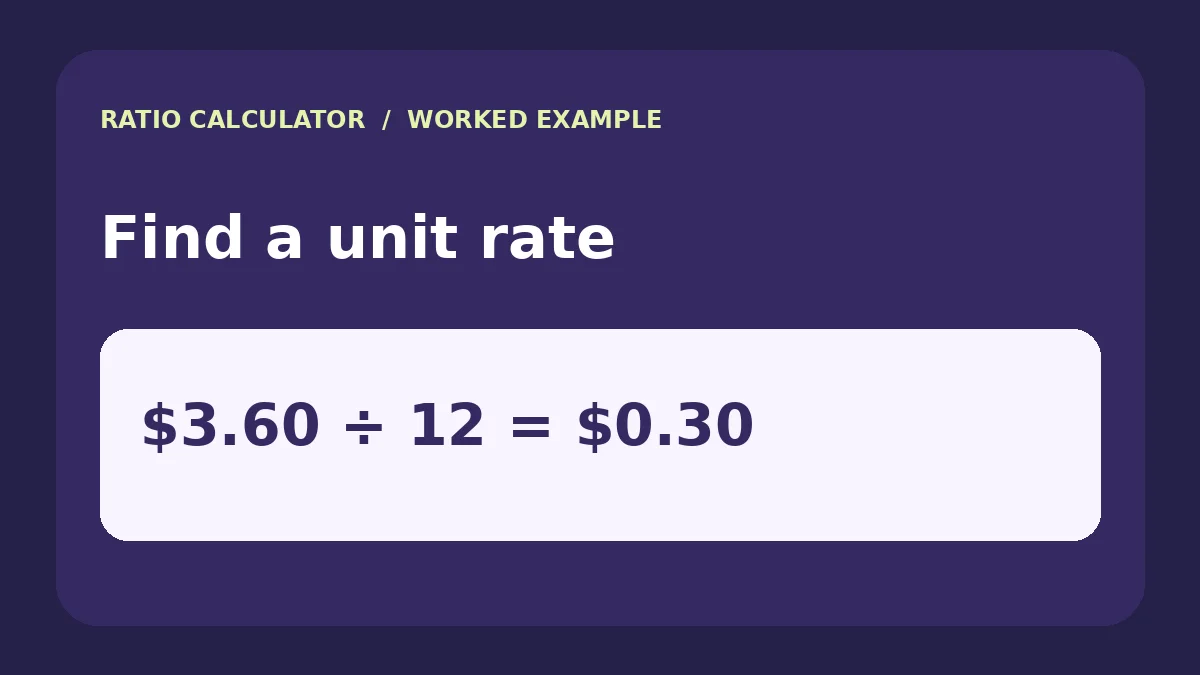
    How to Find a Unit Rate

    Divide the amount by the number of units to express it per one unit. Keep the unit labels in the answer.

    Worked example

    A 12-ounce package costs $3.60, so it costs $0.30 per ounce. A 20-ounce package at $5 costs $0.25 per ounce.

    Check your answer

    Compare prices in the same unit and round after comparing the rates.

    Try the Ratio Calculator or explore the Ratio Guides.
  • How to Find Equivalent Ratios

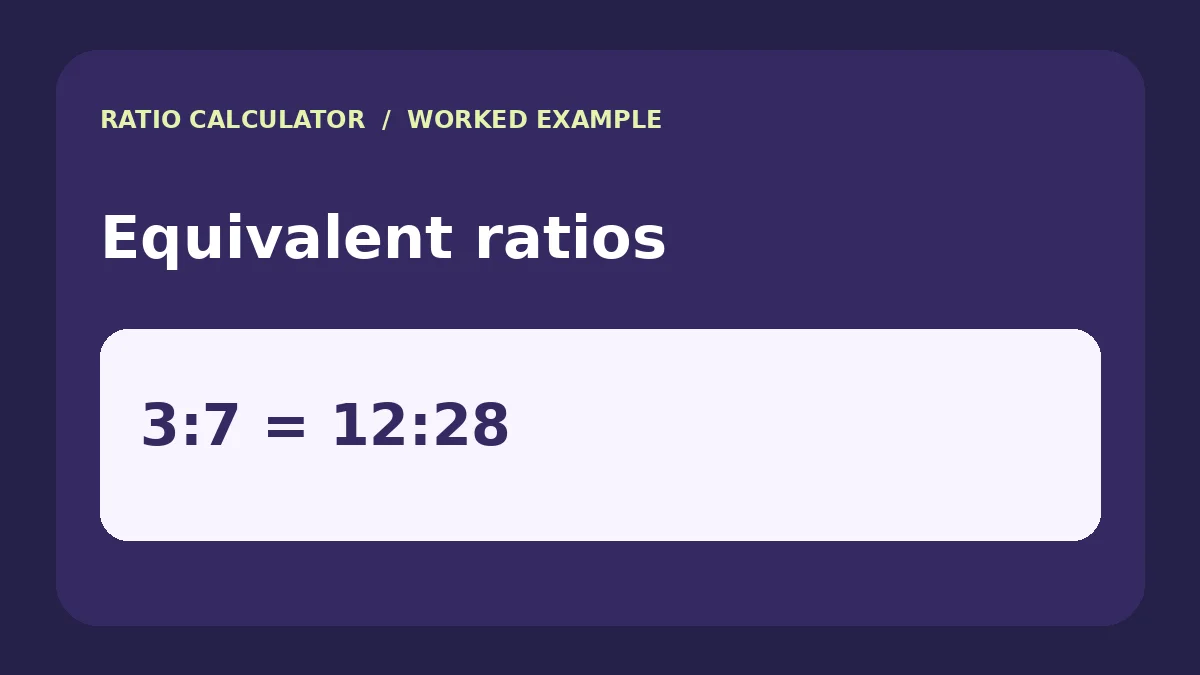
    How to Find Equivalent Ratios

    Multiply or divide both terms by the same positive factor. This keeps the relationship between the terms constant.

    Worked example

    Multiply 3:7 by 4 to get 12:28. Divide 12 and 28 by 4 to return to 3:7.

    Check your answer

    Adding the same number to each term generally changes the ratio. For instance, 4:8 is not equivalent to 3:7.

    Try the Ratio Calculator or explore the Ratio Guides.
  • How to Solve a Proportion With a Missing Value

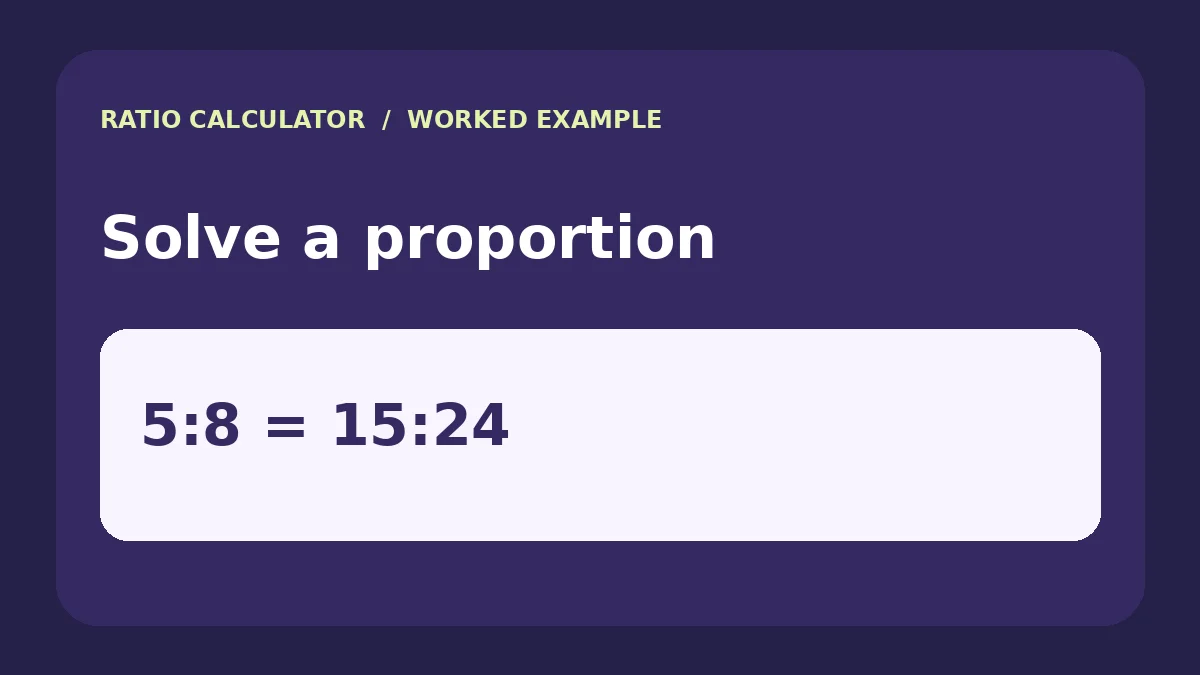
    How to Solve a Proportion With a Missing Value

    Keep matching quantities in the same positions on both sides of the equation. Then use equal cross-products to solve for the unknown.

    Worked example

    For 5:8 = 15:x, cross-multiply to get 5x = 120. Divide by 5 to get x = 24.

    Check your answer

    Reduce 15:24 to 5:8 and check that neither denominator is zero.

    Try the Ratio Calculator or explore the Ratio Guides.
  • How to Calculate Aspect Ratio From Width and Height

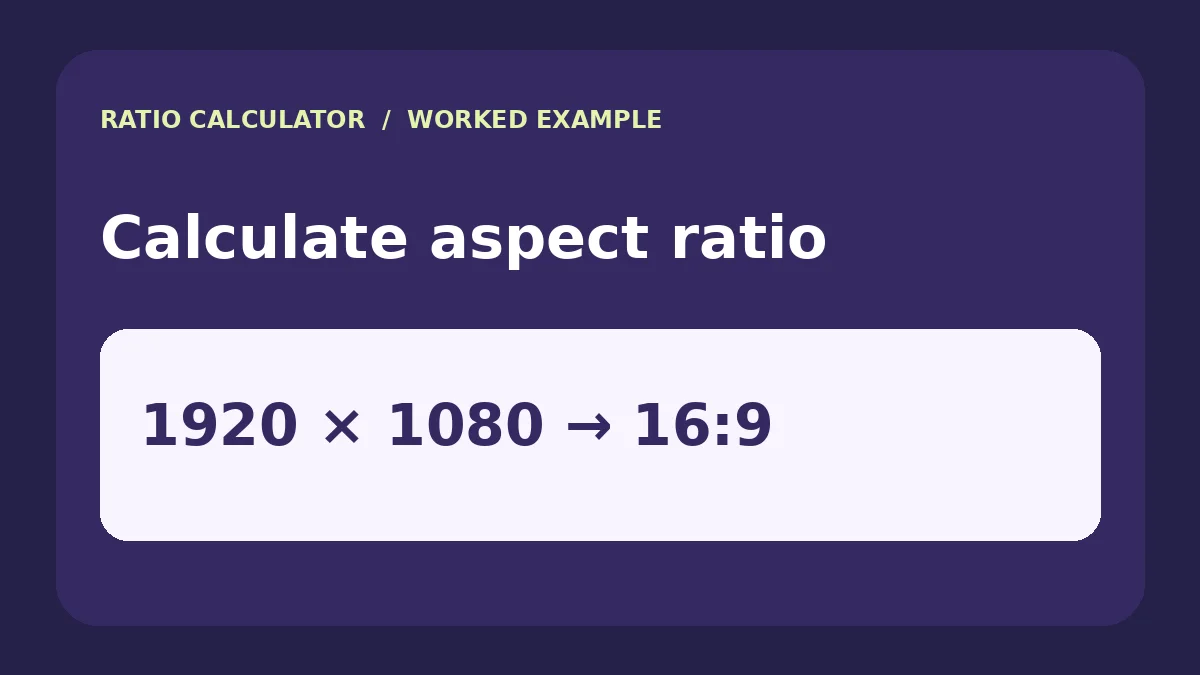
    How to Calculate Aspect Ratio From Width and Height

    Write width first and height second, using the same unit for both. Reduce the terms by their greatest common divisor.

    Worked example

    A 1920 × 1080 image reduces to 16:9. At a width of 1280 pixels, preserving 16:9 requires 1280 × 9 ÷ 16 = 720 pixels of height.

    Check your answer

    A portrait image reverses the terms. Resize both dimensions proportionally to avoid stretching.

    Try the Ratio Calculator or explore the Ratio Guides.
  • How to Split a Total in a Ratio

    How to Split a Total in a Ratio

    Add the ratio terms to find the total number of parts. Divide the total by that sum, then multiply by each term.

    Worked example

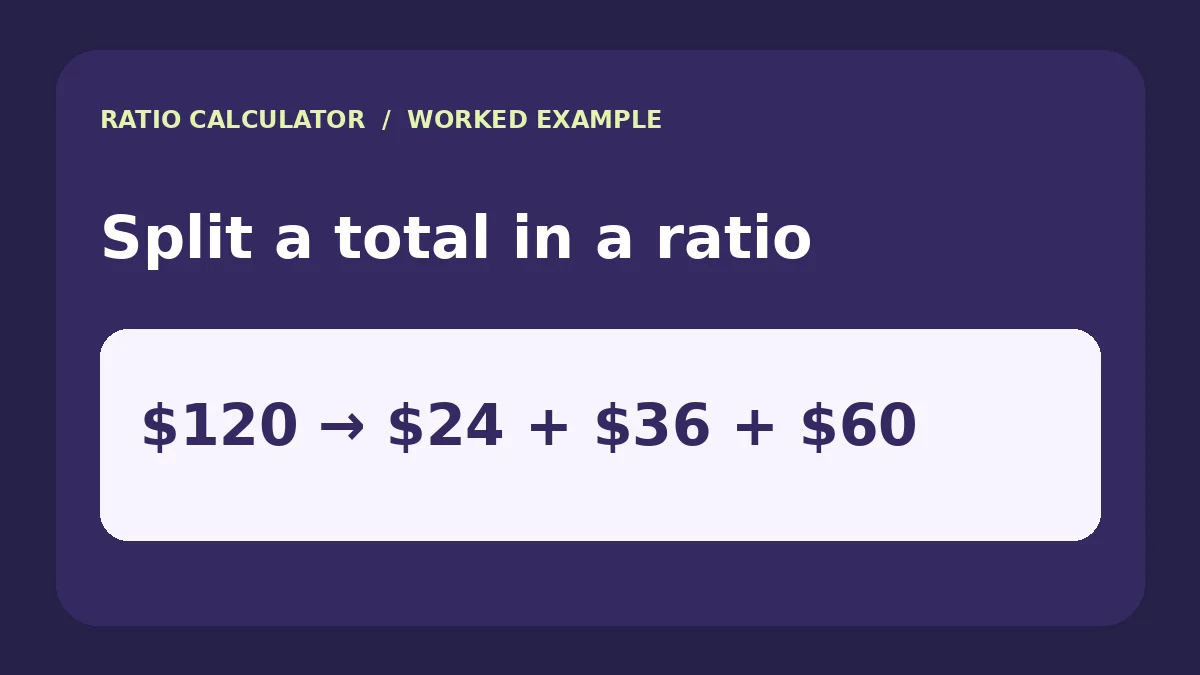
    Split $120 in the ratio 2:3:5. There are 10 parts and each is worth $12. The shares are $24, $36 and $60.

    Check your answer

    Check that the shares add back to the original total. If you must round to cents, distribute the rounding remainder explicitly.

    Try the Ratio Calculator or explore the Ratio Guides.
  • How to Convert a Ratio to a Percentage

    How to Convert a Ratio to a Percentage

    Decide what the percentage is of. For 2:3, the first term is 2 ÷ 3 × 100 = 66.67% of the second term.

    Worked example

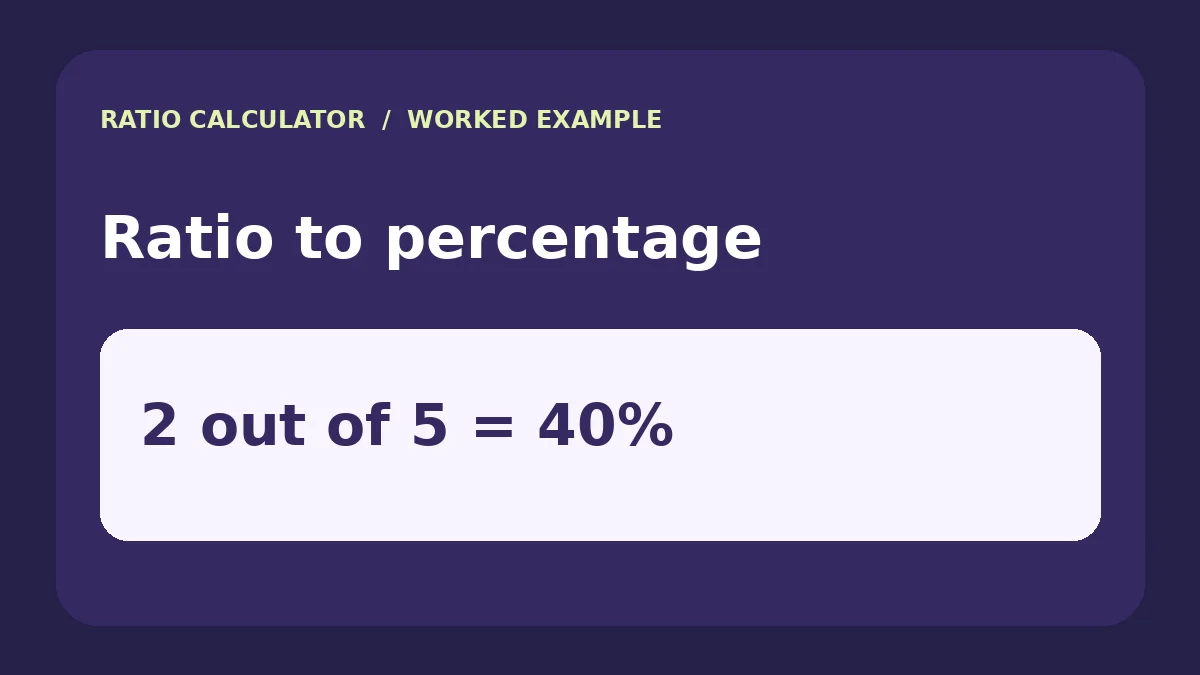
    To find the first term as a share of the whole, divide by the sum: 2 ÷ (2 + 3) × 100 = 40%. The second share is 60%.

    Check your answer

    Check the wording. “As a percent of water” and “as a percent of the mixture” have different denominators.

    Try the Ratio Calculator or explore the Ratio Guides.